


His has been the shortest term of any bishop in Rochester diocesan history.
Even so, Blessed Fulton J. Sheen’s 34-month tenure — from December 1966 to October 1969 — had a major impact.
For starters, local Catholics were being led by the most recognizable priest in the United States, thanks to his massively successful radio and television career over the previous 30-plus years.
Then-Bishop Sheen launched landmark initiatives in the Diocese of Rochester, eagerly implementing priorities of the recently concluded Second Vatican Council. He also took innovative approaches to social issues of the era, particularly poverty.
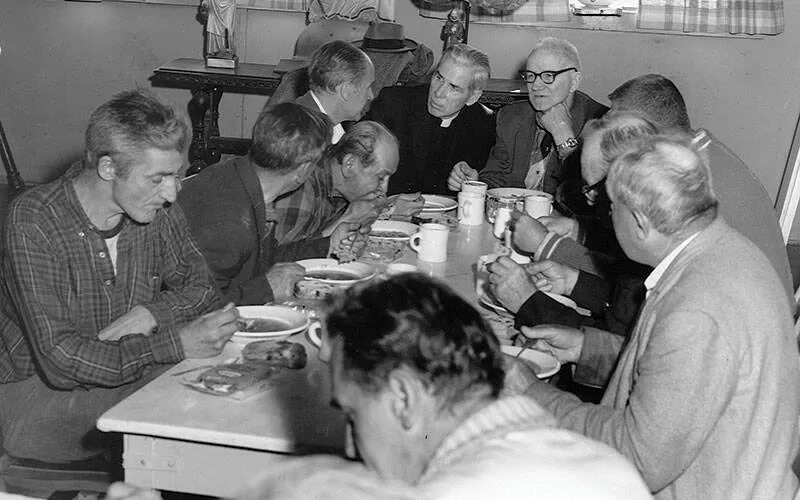
“He was deeply committed and outspoken about the plight of the poor,” said Father Frank Lioi, a senior diocesan priest who was ordained by Bishop Sheen in 1967.
Father James Schwartz, whom Bishop Sheen ordained in 1968, described him as a “very inspiring man, a very holy man” who was well-deserving of beatification on Sept. 24, 2026.
However, Fathers Schwartz and Lioi observed, Bishop Sheen’s time in Rochester was marked by many admirable initiatives that achieved only mixed success.
“He was not so much an administrator. He was a visionary,” said Father Schwartz, the current pastor of St. Joseph and Holy Spirit parishes in Penfield.
Bishop Sheen drew thousands when arriving at Rochester airport
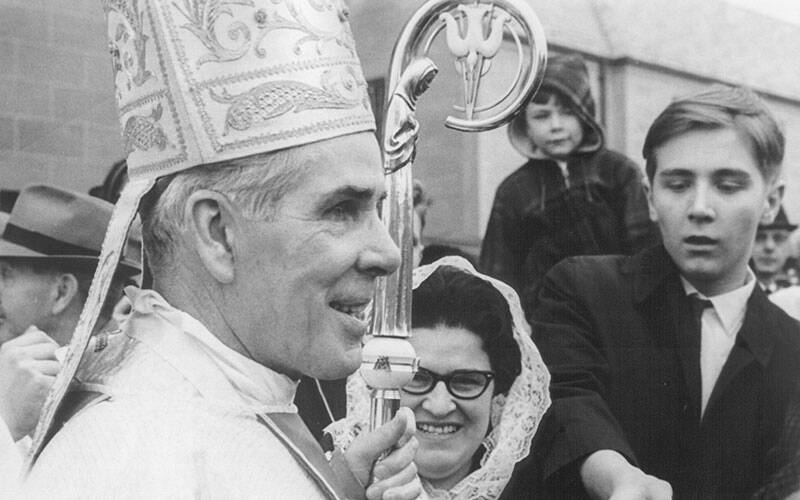
Excitement over Pope Paul VI’s appointment to Rochester of Bishop Fulton J. Sheen was evident on Dec. 14, 1966, when a reported 3,000 well-wishers greeted him at what is now known as the Frederick Douglass Greater Rochester International Airport. He was installed as bishop the next day at Sacred Heart Cathedral by Cardinal Francis Spellman, archbishop of New York.
Bishop Sheen succeeded Bishop James E. Kearney, who had led the Rochester Diocese for 29 years before retiring. Blessed Sheen came from the New York Archdiocese where, from 1951 to 1966, he served as auxiliary bishop as well as national director for the Society for the Propagation of the Faith — an international missionary initiative — while continuing his broadcasting endeavors.
Fathers Lioi and Schwartz recalled that on the same day he arrived in Rochester, Bishop Sheen visited St. Bernard’s Seminary, where both priests were then seminarians.
“We were all in our cassocks just waiting, then all the sudden the front door opened. He came in, and there was great applause,” Father Lioi recalled.
For Father Schwartz, the appearance enabled him to see in person the man whose weekly TV show, “Life Is Worth Living,” had influenced his decision to enter the seminary in 1956.
“I think Fulton Sheen was a part of the vocational story for myself and for my family,” said Father Schwartz, whose nephew, Franciscan Father Jason Hood, also is a priest.
Bishop Sheen remained a popular public figure throughout his tenure in upstate New York. Father Lioi recalled that the bishop, who lived in downtown Rochester, would draw big crowds as he walked to the nearby Eastman School of Music, simply by conversing in the entrance area.
“He would do the talking, not you,” Father Lioi said. “What he said, and how he said it, was so interesting that you didn’t want to interrupt.”
Priest describes Bishop Sheen’s initiatives as ‘a dramatic adjustment’
As a first-time diocesan leader, Bishop Sheen — who had attended all four sessions of the Second Vatican Council in Rome (1962-1965) — plunged into implementing the council’s priorities.
With English having begun to supplant Latin as the language of U.S. Masses before he arrived, Bishop Sheen promoted other Vatican II ideals by increasing lay participation in such liturgical roles as lectors, musicians and extraordinary ministers of holy Communion. He also called for more lay people in parish and diocesan decision-making roles.
“In those days, they were starting parish councils, liturgy committees, social-justice committees,” Father Lioi noted. “It was an immediate adjustment, a dramatic adjustment. And I think after that, things were never quite the same in Rochester.”
In addition, Bishop Sheen ordained the first-ever permanent deacon in the United States, Michael Cole, in 1969 — some 13 years before the first class of permanent deacons was ordained here.
Also high on Bishop Sheen’s list of Vatican II objectives was increasing in ecumenical and interfaith dialogue. For example, he sought to partner with local Protestants in such areas as urban ministry and theological studies.
Meanwhile, Father Schwartz recalled, Bishop Sheen called for an adjustment in priestly formation to include a real-world outlook.
“Before, you were set apart in seminary formation. (He said that) if we are going to form priests, we need to form them to engage in the world. He had this kind of missionary perspective,” Father Schwartz remarked.
Bishop launched several initiatives in Rochester Diocese to aid the poor
Bishop Sheen’s time in Rochester also coincided with deep nationwide unrest over such issues as assassinations, U.S. military involvement in Vietnam and the countercultural movement. The 1960s also were defined by a growing societal focus on poverty and systemic racism, a concern that absorbed much of Bishop Sheen’s energy.
He established a rural ministry known as the Secular Mission that ministered to the rural poor in diocesan counties south of Rochester; and he focused intently on improving the lives of impoverished urban residents.
“The inner city became a rallying cry of an awakened social consciousness,” Bishop Sheen wrote in his 1980 autobiography, Treasure in Clay.
To that end, he established an Office of Urban Ministry for the local African-American community, created a Spanish Apostolate for the growing Latino population, and initiated an effort to better fund Rochester’s inner-city Catholic schools. In 1968 he also founded the Bishop Sheen Ecumenical Housing Foundation, which continues today to work toward securing suitable housing for low-income residents across a 13-county area.
Not all of Bishop Sheen’s plans for Rochester Diocese came to fruition
But it was in striving to assist the poor that Bishop Sheen made what is largely considered his most controversial move as Rochester’s sixth bishop.
In January 1968, he unexpectedly announced his intention to give Rochester’s St. Bridget Church and its surrounding property to the federal government to be used as a site for low-income housing. So intense was the pushback from local clergy and faithful — which he termed a “great surprise” in his autobiography — that he almost immediately scrapped the plan.
His initiative was rejected “chiefly because there had been no preliminary dialogue with those involved,” even though the idea actually had merit, Father Robert F. McNamara noted in his diocesan history, The Diocese of Rochester in America 1868-1993.
Another unfulfilled quest of Bishop Sheen’s was to dissolve the Catholic Courier Journal (a former name of this newspaper) in favor of buying a weekly page in secular newspapers throughout the diocese for the stated purpose of reaching a wider audience. He dropped the idea only upon discovering that a printing contract for the Courier still had years remaining.
Father Lioi also recalled Bishop Sheen’s unrealized effort to expand lay and interfaith offerings of St. Bernard’s Seminary by inviting world-class theologians to join its faculty.
“He never consulted the trustees, the budget, how St. Bernard’s was going to pay for these people,” remarked Father Lioi, who served from 1974-81 as the seminary’s rector, assistant professor of liturgical studies, and director of liturgy and music.
Bishop Sheen departed Rochester in late 1969; returned to New York City
Bishop Sheen announced his resignation Oct. 6, 1969, although his request had been approved by Pope Paul VI several months earlier. He was succeeded by Bishop Joseph L. Hogan. Then 74 years old, Bishop Sheen returned to New York City, where he spent the last 10 years of his life writing, preaching, conducting retreats and logging regular media appearances.
His stint in Rochester was the only time he actually governed a diocese, despite holding the title of “bishop” more than once. During his 15 years as an auxiliary bishop of the New York Archdiocese, he held the ceremonial position of titular bishop of Caesariana, and upon his retirement as sixth bishop of Rochester, Pope Paul VI elevated him to titular archbishop of Newport, Wales. Since that time, he has been commonly known as Archbishop Sheen.
Writing in his diocesan history, Father McNamara observed that after “meteoric beginnings in Rochester,” Bishop Sheen ultimately was hampered by a lack of administrative and pastoral experience; a background as an orator that rendered him as “a monologist, not a dialogist”; and a leadership style that was high on ideas but low on follow-through.
Father McNamara also observed that Bishop Sheen wasn’t the same after the St. Bridget controversy: “The wound was deep and never really healed,” he wrote, adding that the fallout was an especially sharp blow to a man whose career up to that point “had been one of constant success.”
Bishop Sheen’s positive influence in Rochester Diocese endures ‘to this day’
Although his success in Rochester was checkered, Bishop Sheen ultimately exerted a positive influence, paving the way for today’s diocesan church. His influence can be seen in the expansion of lay roles; emphasis on the permanent diaconate, leading to the ordination of hundreds of men in the Rochester Diocese since 1982; and the ecumenical housing coalition that continues in his name.
In addition, in 1967, Bishop Sheen began negotiations to blend St. Bernard’s Seminary with Colgate Rochester Crozer Divinity School and Bexley Hall, an Episcopal seminary, to create an ecumenical theological center. Although that plan never reached fruition, Bishop Sheen did succeed in instituting lay offerings at St. Bernard’s, which allowed it to continue as a theological institute — today known as St. Bernard’s School of Theology and Ministry — after the seminary closed for priestly formation in 1981.
His ideas and actions were the mark of a man whom Father Schwartz called “a great visionary.” Meanwhile, Father McNamara dubbed him “a thoroughly good and dedicated priest,” noting that despite his celebrity status, “he countered any tendency to vainglory by his devotion to the cross of Christ, by his daily hour before the Blessed Sacrament, by his childlike affection for the Mother of God, and by his all-embracing charity (including donation of all his considerable media proceeds).”
To have been ordained by such a historic figure — who is now just one step from sainthood — is “quite an honor, actually,” Father Lioi said.
“It’s the grace of God,” Father Schwartz agreed, adding, “He was a man of deep faith. He inspires me to this day.”
Tags: Blessed Fulton J. Sheen, Priests
